
An under-sink organizer succeeds when its dimensions, slide action, construction, storage layout, cabinet fit, assembly route, and packaging suit a real plumbing-constrained space. This guide helps buyers compare an under sink organizers manufacturer, assess wholesale under sink organizers, and prepare a private-label brief with product application, installation preparation, factory testing, and shipment inspection in view.
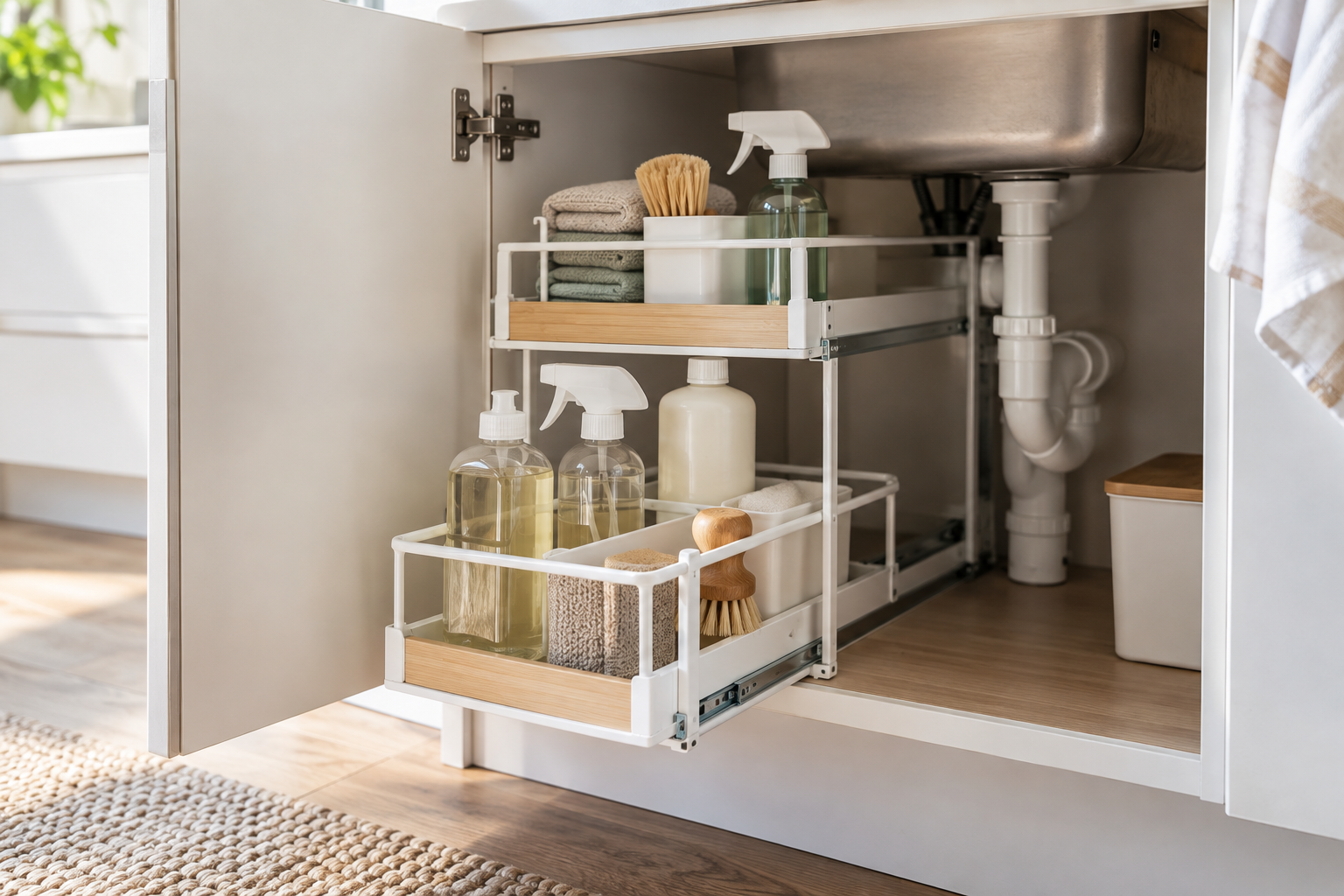
1. The buyer's answer: how to approach under sink organizers manufacturer: wholesale and private label buyer guide
Choose an under sink organizers manufacturer by defining the cabinet and storage task before selecting a tier count or colour. Cleaning bottles, sponges, cloths, refills, and kitchen accessories create different height, access, load, drainage, and plumbing-clearance needs. The initial brief should state target market, intended cabinet type, width and height envelope, plumbing assumptions, format, material and finish direction, channel, quantity range, target price position, retail pack, and delivery timing. Wholesale under sink organizers, under sink organizers supplier, under sink organizers manufacturer, private-label under sink organizers, custom under sink organizers, and OEM under sink organizers are commercial descriptions rather than a fit specification. A credible supplier should identify overall and usable dimensions, basket configuration, rail or slide route, material thickness, finish, assembly method, loading assumptions, fasteners or feet, retail pack, carton plan, and inspection points. This prevents buyers from comparing a simple shelf with a pull-out system as if they offered the same customer result. For a first range, create distinct product roles. A compact single-tier caddy, a two-tier pull-out organizer, and a wider configurable format can give shoppers clear choices without unnecessary duplication. Each SKU should solve a known cabinet-use problem and make the required installation preparation obvious.
The most reliable route is to make the buying decision visible before asking for a final price. State the target market, intended channel, product role, quantity range, and any non-negotiable requirement. This turns a broad catalogue request into a reviewable brief and gives both parties a clearer basis for sample, packing, and shipment preparation.
2. Build the commercial decision before comparing quotations
Ask each under sink organizers supplier to quote from the same written brief. A comparable quotation should state overall and usable dimensions, basket count, rail or slide construction, material and finish, assembly, accessories, unit pack, inner pack, master carton, quality scope, lead-time assumption, and delivery term. A lower wholesale price may reflect a shorter slide, thinner material, simpler coating, fewer components, different pack, or reduced carton protection; it should not be treated as equivalent until these assumptions are documented. Private-label under sink organizers can be differentiated through finish, basket arrangement, handle, liner or tray, instruction format, branded packaging, and selected accessories. Confirm which custom under sink organizers changes affect tooling, component availability, assembly, sample approval, MOQ, lead time, carton cube, or retail claims. The buyer should approve instructions and compatibility language; the manufacturer should retain a versioned product-and-pack reference throughout production. Include retailer setup and freight in the commercial decision. A fully assembled system may reduce shopper friction but increase carton volume. A flat-pack system can improve container use but needs clear assembly and parts control. The strongest OEM choice balances cabinet usability, perceived quality, return-risk reduction, shelf presentation, and freight—not only the headline unit cost.
Compare like with like. A lower unit price can reflect a different material route, component set, pack configuration, carton quantity, or inspection scope. Ask suppliers to show the assumptions behind a quotation and retain the version with the selected option. That record is useful when the approved sample, shipment inspection, and invoice are reviewed later.
| Review point | Buyer decision | Evidence |
|---|---|---|
| Cabinet use | Cabinet envelope, plumbing clearance, stored items and access | Buyer brief and mock-up review |
| Product system | Frame, baskets, rails, stops, feet, hardware and finish | Specification and approved sample |
| Packing | Assembly information, parts control, protection, inner pack and carton | Packing plan and photos |
| Release | Dimensions, slide action, component count and shipment condition | Factory testing and inspection record |
3. Define the product evidence a buyer should see
Document every working part: frame, baskets, rails or slides, stops, handles, feet or pads, screws or clips, liner or tray, finish, dimensions, maximum intended storage guidance, assembly steps, instruction sheet, label areas, and retail pack. Separate outside dimensions from usable basket dimensions and record the plumbing-clearance assumption. This makes the product application understandable before a buyer or shopper discovers a fit issue at home. Review the sample in a representative cabinet mock-up. Check that baskets pull smoothly, stops engage as intended, the frame sits level, products can be retrieved, tall bottles clear the upper structure, and the stated assembly steps are reasonable. This is a useful installation preparation and factory testing checkpoint; it is not a basis for broad universal-fit claims. A single cabinet layout cannot represent every plumbing route, so compatibility wording should remain specific and supportable. For material and finish decisions, compare surface quality, cut edges, joints, slide feel, contact points, and selected load arrangement. If a product is described as rust-resistant or heavy duty, use the wording only when the exact construction, intended environment, and evidence support it. A buyer-approved sample should show the selected product system rather than a visual render alone.
Use the approved sample as a shared reference rather than relying on a product image alone. In practical factory testing, this means checking the visible parts, assembly, fit, moving components, count, and any agreed function against a documented reference. It is better to describe a limited, testable condition than to use a broad marketing claim that cannot be verified.
4. Make sample approval and factory checks specific
Agree factory testing and shipment inspection before production. Depending on the approved organizer, useful checks can include component identity, overall and usable dimensions, frame alignment, slide travel and stops, basket fit, finish, feet or pads, fastener count, selected assembly check, instruction and retail-pack presentation, and master-carton protection. The inspection plan should follow the selected construction and buyer-approved reference, not a generic storage-product checklist. Keep evidence at meaningful control points: approved sample photos, pre-production finish and component confirmation where needed, assembly or slide-operation photos, packed-unit photos, finished product and carton photos, and inspection findings with corrective actions. When dimensions, rail route, finish, pack, or instructions change, record the revision and approval owner before release. During shipment preparation, check that rails and baskets are restrained, loose components are bagged and counted, edges are protected, instructions remain paired to the correct version, and cartons prevent movement in transit. Confirm inner-pack count, carton marks, carton quantity, and pallet instructions where relevant. A smooth sample slide can still arrive with damage if components are not controlled inside the export carton.
Before goods are complete, agree the inspection timing, the approved product and pack references, the critical functions, visible tolerances, and the action route if a finding needs correction. A factory quality check or third-party shipment inspection can then report against an agreed scope instead of making an improvised judgement on the day.

5. Treat retail packing and export packing as part of the product
Retail packaging should explain the organizer format, key dimensions, selected cabinet-use route, set content, and approved assembly information without making unsupported universal-fit claims. Reserve room for barcode data, country-of-origin wording, market-specific copy, verified product facts, and safe handling information. The chosen sleeve, colour box, or flat-pack carton must hold rails, baskets, hardware, and instructions together. For export packing, review the component sequence, protective sleeves or boards, hardware bags, instruction placement, inner-pack configuration, carton quantity, carton marks, and pallet pattern. Packing photos should show how slide components, finished surfaces, and small parts are protected rather than only the outside carton. Before dispatch, request photos of the assembled organizer, rails and stops, basket and frame details, hardware pack, instruction placement, retail pack, internal protection, inner pack, and master carton. This connects the buyer-approved product version to the actual shipment record.
Ask for a pre-production photo set before mass production is finished: the product in the retail pack, front and back panels, internal protection, barcode area, inner pack, and master carton. This simple record helps product, logistics, and buying teams identify a mismatch while there is still time to correct it.
6. Send a sourcing brief that earns a useful reply
Send DayMild the target market, cabinet width and height envelope, plumbing assumptions, intended stored items, reference products, organizer configuration, material and finish preference, expected quantity, target price position, private-label requirements, packaging route, delivery goal, and known retailer requirements. Tell us whether you need ready wholesale under sink organizers, a private-label range, or custom OEM development. Use the same brief when comparing suppliers so dimensions, slide construction, assembly, pack, quality scope, and delivery assumptions can be evaluated consistently. Browse the kitchen storage supplier guide, Soft-Grip Cleaning Caddy, and homeware product specification sheet guide for related sourcing work. Send your requirements with the market, quantity range, cabinet constraints, and delivery target. DayMild will respond with relevant product formats and the next sample, installation, packing, and inspection questions to settle before production.
A short, honest first brief is enough to start. DayMild can help buyers translate a category idea into a product, packaging, and quality discussion. Browse our DayMild home organization formats to see relevant formats, then send the destination market, target quantity, preferred delivery window, and the questions your team needs answered.
Frequently asked questions
What should I ask an under sink organizers manufacturer before requesting a quote?
Share the target market, cabinet width and height envelope, plumbing assumptions, stored-item route, organizer format, quantity range, target price, pack route, delivery timing, and known retailer requirements.
How should I compare wholesale under sink organizers?
Use one written brief and compare overall and usable dimensions, basket configuration, slide or rail construction, material and finish, assembly, components, retail pack, carton quantity, quality scope, lead time, delivery term, and supplier assumptions before comparing price.
Can a supplier make private-label under sink organizers?
A supplier may support buyer-approved finish, basket layout, accessories, branded packaging, and instruction format. Confirm tooling, sample approval, MOQs, assembly route, compatibility language, and component protection before production.
What should under sink organizer shipment inspection check?
The agreed plan can include component identity, dimensions, frame alignment, slide action and stops, finish, hardware count, assembly check, instruction placement, retail-pack condition, carton protection, and required markings against the buyer-approved reference.
How can I start a homeware sourcing enquiry?
Send DayMild the product category, target market, estimated quantity, pack requirements, timeline, and the most important buying questions. We will help identify the next product, packing, and quality decisions to review.
Conclusion: make the handoff clear before production
Good homeware sourcing is not about asking a supplier to promise everything. It is about defining the product, retail presentation, and inspection evidence that matter for the selected market. The clearer the approved brief, the more useful the quote, sample review, factory testing, and shipment handoff become.
When you are ready, get an under sink organizer quote with your category, market, and buying priorities. DayMild will respond with relevant product options and the next practical questions.