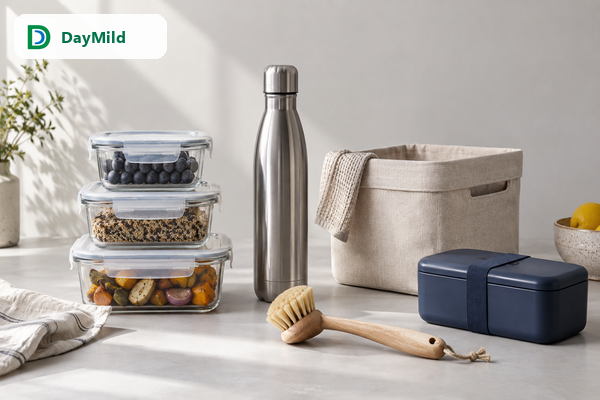
Retail food-storage products are easy to underestimate. A container has to be clear enough to understand, practical enough to use repeatedly, appropriate for its intended market, and protected well enough to arrive retail-ready. This guide gives buying teams a usable brief and review process before they commit to samples or production.

1. Start with the storage job, not the shape
The first sourcing question is not 'round or rectangular?' It is 'what will the shopper store, where will the container live, and what frustration must it remove?' A pantry canister, a clip-lid fridge bin, a lunch container, and a reusable food bag may all sit in a kitchen category, yet they have different priorities. The pantry buyer wants visibility and stack stability. The lunch buyer may care more about closure confidence, compact dimensions, and easy cleaning. The refrigerator buyer needs fast access and a format that makes contents visible without opening every lid.
Write a one-sentence use promise before reviewing supplier catalogues. For example: 'A clear, stackable dry-food container that helps a shopper see weekly staples at a glance.' That sentence becomes a practical filter for the capacity range, opening size, lid construction, label space, photography, and packaging claims. It also prevents an assortment from becoming a set of attractive but disconnected shapes.
In a supplier conversation, specify whether the product will be used for dry goods, prepared food, refrigerator organization, lunch transport, or a mixed home-storage use. Ask how the proposed format nests when empty, stacks when full, and behaves when a shopper opens it with one hand. These are not minor details. They determine whether a product earns repeat use after the initial purchase.
2. Build a range that is clear to shop and simple to replenish
A first retail range does not need every possible size. It needs an understandable role for each SKU. Many buyers start with a good-better-best structure: an accessible single piece, a core container with the most broadly useful feature set, and a trade-up multi-size or stronger-seal format. The approach gives shoppers an entry point without forcing the buying team to manage a large number of untested variants.
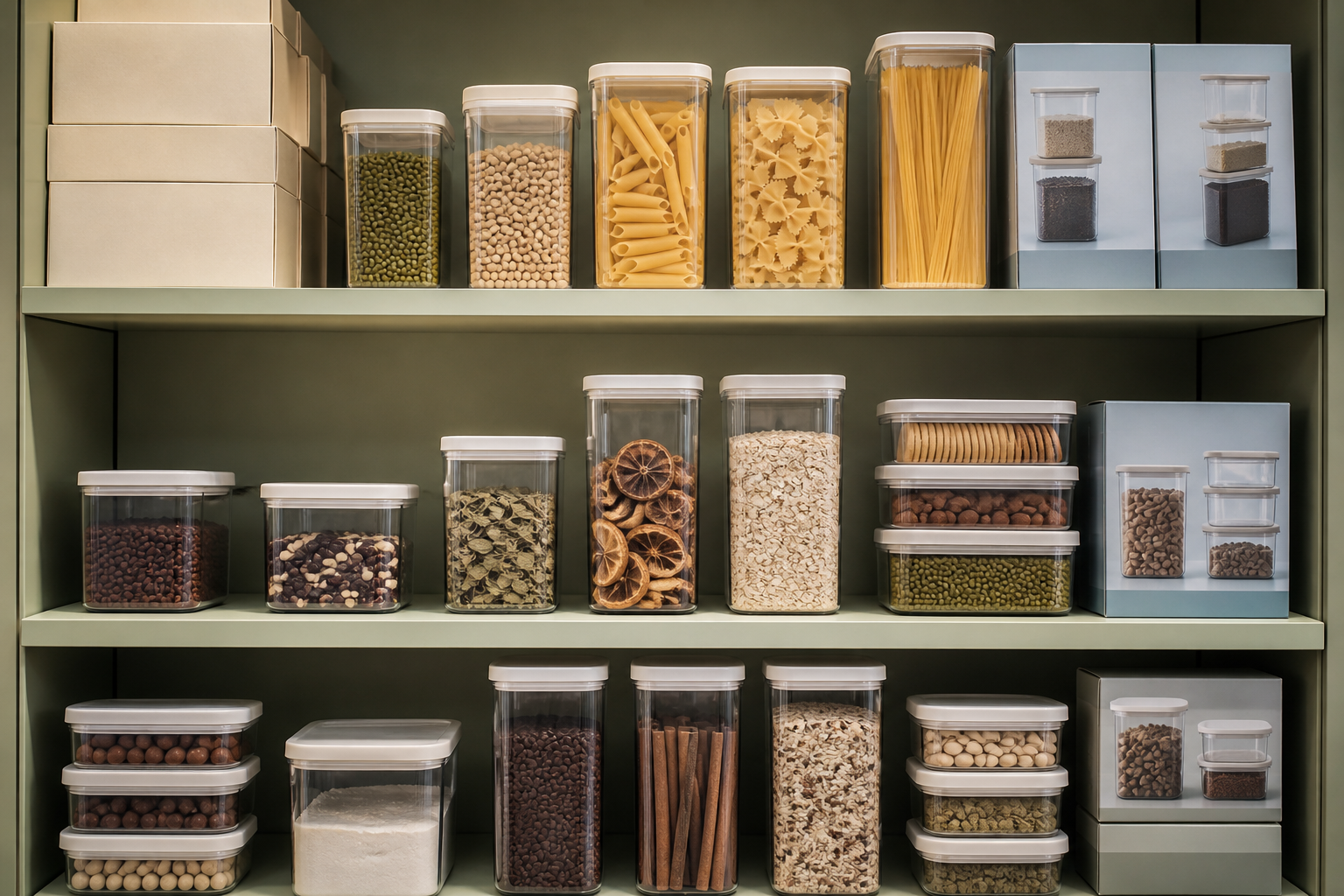
Use a capacity ladder that reflects actual household use rather than arbitrary volume jumps. Small formats can support snacks, leftovers, or ingredients. Medium formats often carry the core weekly use. Larger formats suit bulk dry goods or family preparation. The final capacities should come from the selected product geometry and the buyer's positioning, but the range should read as a system when shown in a catalogue, on a shelf, or in an online collection image.
Keep early colour and material choices disciplined. A clear body plus one coordinated lid or clip colour is easier to merchandise than a broad mix of unrelated finishes. The same discipline helps during production: fewer colour standards, component combinations, and retail-pack variations make approved samples easier to compare during factory testing and shipment inspection.
| Range decision | Buyer question | Evidence to request |
|---|---|---|
| Capacity ladder | Which use moment does each size serve? | Dimension and nominal-capacity drawing |
| Closure route | Is the product for dry storage, refrigerated food, or transport? | Working sample and function-check notes |
| Merchandising | How will the family read on shelf or online? | Family photo, pack mock-up, and carton plan |
3. Choose the material route by intended use
A material name is not a complete sourcing decision. Buyers should ask which material is used for the body, lid, clips, gasket, colourant, decoration, and any assembled part. Clear PP, PET, and copolyester routes can look similar in a quick product image while differing in appearance, stiffness, processing, care expectations, and the conditions for which the finished article is specified. The right choice starts with the use brief, not with a generic marketing claim.
Give the supplier the destination market, expected food type, temperature exposure, storage duration, and cleaning routine as early as possible. A container used for room-temperature dry goods does not create the same review questions as one intended for hot food, oily food, freezer use, or repeated dishwasher cycles. The request should also identify whether the buyer needs a particular transparency level, matte finish, recycled-content route, or a specific consumer-care statement.
For food-contact articles, use precise language. The FDA describes food-contact substances as materials or components that come into contact with food, including packaging, cookware, and food-storage containers. In the EU, food-contact materials must meet applicable safety and manufacturing requirements before being placed on the market. Those sources provide regulatory context; they do not replace documentation for the actual materials, components, intended use, and market. A supplier should not promise broad suitability from a photo reference alone.
4. Review seals, lids, and everyday handling as a system
A closure is more than a lid sitting on a body. The buyer should look at the rim, seal channel, gasket fit, clip force, hinge movement, and the way all components align after repeated opening. If the range includes a silicone gasket, ask how it is seated, whether the consumer can remove it for cleaning, and how the factory confirms that it is present and correctly fitted during assembly. If the format uses clips, check whether they close evenly and whether their geometry interferes with adjacent containers when stacked.
Use an approved sample for simple, repeatable functional checks. A team may compare lid fit, opening action, visible flash, sharp edges, nesting, stacking, and the condition of the seal after an agreed number of open-close cycles. The exact method belongs in the buyer's approved specification. The point is not to create a theatrical test; it is to agree which functions matter and record what an acceptable sample looks and feels like.
Avoid turning a useful design point into an overbroad claim. 'Leak-resistant' should be used only when the finished product and claim wording are supported by the agreed use conditions and evidence. 'Easy to clean' should be linked to the real component geometry and care instructions. Clear language is better for a shopper, a retailer's legal team, and an AI answer engine than a long list of vague superlatives.
5. Ask for documentation that matches the product and market
Documentation works when it follows the actual product brief. Provide the destination market, product description, material route, intended food contact, use temperature, and care conditions. Then ask the supplier which documents or test information are available for that route and which items require buyer confirmation. This is a more useful starting point than asking for a generic 'certificate' without defining the intended use.
For EU plastic food-contact articles, the European Commission explains that a Declaration of Compliance is supported by information on the composition and compliance reasoning for the material or article. The documentation chain matters because a lid, container body, colourant, printing element, or gasket can each affect the finished product review. For U.S. products, the FDA's food-contact resources explain the role of intended use and authorised food-contact substances. Local legal and compliance review remains the buyer's responsibility.
A practical document request list includes the current product specification, material declaration where relevant, product-use statement, available test reports or supporting documents, traceability information, artwork and label proof, and the name of the party issuing each document. Keep version dates visible. A correct document for an earlier material or an unapproved colour variant may not support the product that will actually ship.
6. Treat retail packaging as part of product development
A storage container can meet the brief and still disappoint if the retail pack hides the opening mechanism, lets pieces rub together, or leaves the shopper uncertain about capacity and care. Before artwork is final, decide what must be understood in the first five seconds: the number of pieces, capacity, stackability, core use, and any approved care instruction. Keep the front panel focused; use the back or side panel for detail that supports an informed purchase.
During packing preparation, compare the product inside the pack with the approved colour and component standard. Check whether sleeves, inserts, hang tags, labels, or colour boxes protect vulnerable edges and keep a multi-piece set together. A pre-production photo set should show the front, back, side, interior protection, barcode area, and master-carton markings. This creates a shared approval trail for product, marketing, quality, and logistics teams.
Carton decisions deserve the same attention. Confirm inner-pack quantities, orientation, separation, and any retailer labelling before goods are ready for shipment. A freight-efficient carton is valuable only if it protects the product and fits the buyer's receiving process. The International Trade Administration notes that Incoterms clarify responsibilities including transport packing and, depending on the agreed rule, pre-shipment inspection costs. Put the practical allocation in the purchase order rather than leaving it to assumption.
7. Turn the approved sample into a useful quality plan
The most useful factory testing and shipment inspection plan is specific enough for two people to reach the same conclusion. It identifies the approved sample, product version, component colour, critical functions, cosmetic tolerance, packing route, carton markings, and documents that must accompany the order. It should be ready before production, not written after the first complaint.
For a clear storage set, common checks may include visible surface defects, lid fit, clip or hinge action, gasket presence, nesting and stacking, count per retail pack, printed information, and carton condition. The exact checklist varies by product. A clear pantry container and a silicone food bag should not inherit the same checklist without review because their failure modes and consumer-use questions differ.
Pre-shipment inspection is a decision aid, not a substitute for a clear brief. Ask for photos beside the approved sample, a record of agreed functional checks, packing verification, and a clear note of any rework or deviation. If you are building a wider homeware range, read DayMild's guide to pre-shipment inspection for plastic homeware before finalising your sampling plan.

8. Send a sourcing brief that helps a supplier give a useful answer
A strong first enquiry does not need every commercial detail. It needs enough context for a supplier to suggest a relevant route. Include the category, destination market, intended use, approximate quantity, target position, preferred material direction, packaging expectation, and delivery window. If you are using a visual reference, explain which part matters: the silhouette, capacity ladder, finish, closure style, or retail-pack logic.
If the range will sit alongside other products, share the visual system as well. A supplier can then recommend a coordinated Modular Pantry Storage Set, Clip-Lid Fridge Bin, or Silicone Food Bag Set without treating each item as a separate project. This makes it easier to review colour, components, and packaging as one customer-facing collection.
The best next step is a short written brief followed by an approved-sample conversation. Ask what information is still missing, which risks should be settled before sampling, and which product options are closest to the required use. That approach saves time without pretending that compliance, material selection, or quality can be decided from a single catalogue image.
Frequently asked questions
What should a retail buyer ask a food storage container supplier?
Share the target market, food and use conditions, required sizes, material preference, closure expectation, packaging route, target quantity, and any documentation or label requirements. Ask the supplier to identify the questions that still need buyer approval.
Does a resin code prove that a container is suitable for food contact?
No. A resin identifier alone does not establish suitability for a particular product, market, food type, temperature, or care condition. Review the finished article and relevant documentation for the intended use.
When should packaging be approved?
Approve packaging before mass production is complete. Review the product in the intended retail pack, protection, copy, barcode area, and carton markings so that product, marketing, and logistics teams work from the same version.
Can a supplier confirm all compliance requirements from a product photo?
No. A photo can guide design direction, but compliance depends on the actual materials and components, intended use, destination market, and applicable documentation.
Conclusion: source the whole product system
A food-storage range succeeds when the buyer sources the whole system: use promise, material route, closure function, documentation, retail packaging, and shipment preparation. The visible container is only one part of the decision.
When you are ready to compare formats, send DayMild your market, category, use conditions, and preferred pack route. We can point you toward relevant product families and the next sourcing questions to settle.